How to Start a Medicinal Herb Garden at Home: A Beginner’s Guide
What if your first herb garden didn’t start with 25 plants, an expensive greenhouse, or half your backyard being dug up?
What if it started with five pots?
One containing chamomile.
One with thyme.
A container of mint.
Perhaps some calendula for color.
And a lemon balm plant that releases a fresh citrus-like aroma when you brush against the leaves.
That is enough to begin.
A medicinal herb garden doesn’t have to look like an apothecary from a historical movie. For most beginners, a small collection of carefully chosen plants is actually the smarter place to start.
You learn what each plant looks like.
You discover how quickly the soil dries.
You see which plants love your sunny patio—and which clearly don’t.
Most importantly, you’re actually gardening instead of spending three weeks designing the “perfect” garden and never planting anything.
So let’s build your first one.
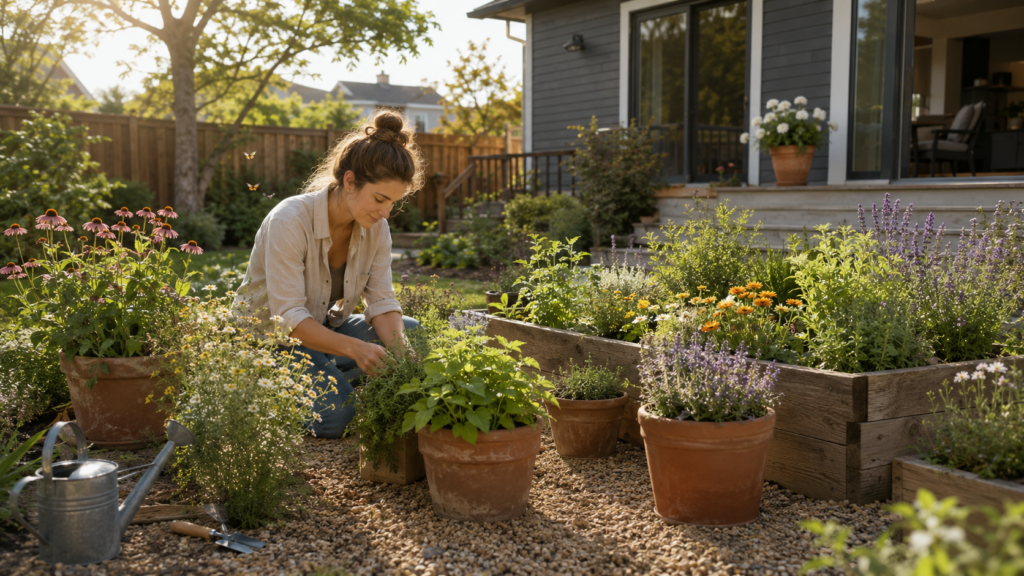
First Question: Where Are You Actually Going to Grow It?
Don’t buy the seeds yet.
Walk outside first.
Or onto your balcony.
Or stand beside the window where you’re imagining rows of herbs.
Your available space determines what kind of medicinal herb garden makes sense.
And fortunately, you have several options.
Which Herb-Garden Setup Fits You?
| Your Situation | Best Starting Setup | Why It Works |
|---|---|---|
| Apartment or condo | Individual pots | Small footprint and easy to move |
| Sunny balcony | Containers + planter boxes | Good use of limited outdoor space |
| Small patio | 4–6 medium containers | Easy beginner setup |
| Backyard | Raised bed + a few pots | More room while keeping plants organized |
| Existing garden | Dedicated herb section | Integrates herbs into your current garden |
| Aggressive spreading herbs | Separate containers | Helps keep vigorous plants contained |
Many common herbs can be grown successfully in containers, which is one reason herb gardening is accessible even for people without large yards.
If you’re completely new…
My preferred beginner setup would be:
4–6 plants in separate containers.
Why?
Because if one plant needs different soil moisture or starts spreading aggressively, you can deal with it individually instead of disturbing an entire garden bed.
Step 1: Spend One Day Watching the Sun
Seriously.
Before planting anything, observe the growing area at different times.
Check it around:
9 AM
12 PM
3 PM
6 PM
You don’t have to stand there all day. Just look periodically.
You’re trying to answer:
How much direct sunlight does this location actually receive?
Many popular herbs perform well with plenty of sun and well-drained soil, although requirements vary significantly between species.
The mistake is assuming:
“It’s outside, so it’s sunny.”
A balcony may receive direct sun for only two hours because another building blocks the rest.
A backyard may look shady in the morning but receive intense afternoon sun.
Know your space first.
Then choose plants that fit it.
Step 2: Choose Plants You Will Actually Enjoy Growing
It’s tempting to search:
“50 medicinal herbs everyone should grow.”
Then suddenly your shopping cart contains seeds you’ve never heard of.
Don’t do that on your first attempt.
Start with recognizable plants that have culinary, fragrant, ornamental, pollinator, or traditional herb-garden value.
Here are some interesting candidates.
Beginner Herb Quick-Reference Table
| Herb | Why It’s Interesting | Container Friendly? | Beginner Note |
| Chamomile | Attractive daisy-like flowers | Yes | Check which species you’re growing |
| Calendula | Bright orange/yellow flowers | Yes | Great visual addition to a garden |
| Peppermint | Strong fragrance, vigorous growth | Definitely | Container helps control spreading |
| Lemon Balm | Fresh lemon-like fragrance | Yes | Can grow enthusiastically |
| Lavender | Fragrant flowers and pollinator appeal | Yes | Likes good drainage |
| Thyme | Compact and useful in cooking | Yes | Excellent dual-purpose herb |
| Sage | Culinary + attractive foliage | Yes | Avoid constantly wet soil |
| Echinacea | Distinctive flowering perennial | Possible | Give it adequate space |
Mint is particularly worth containing because it spreads vigorously, while lemon balm is also known for enthusiastic growth.
A Simple 5-Plant Starter Garden
Feeling overwhelmed already?
Ignore the giant lists.
Here’s a much simpler first garden:
🌼 Chamomile
For delicate flowers and visual interest.
🌿 Thyme
Compact, practical and useful in the kitchen.
🌱 Peppermint
A vigorous plant that teaches you very quickly why containers matter.
🟠 Calendula
Bright flowers that make an herb garden actually look like a garden rather than five pots of green leaves.
🍋 Lemon Balm
Distinctive fragrance and fast growth.
That’s it.
Five plants.
You can always add more once you know what you’re doing.
Step 3: Decide Between Seeds and Starter Plants
Here’s where beginners often assume seeds are automatically the “proper” way.
They’re not.
Both approaches are perfectly reasonable.
Seeds vs. Starter Plants
| Seeds | Starter Plants | |
| Upfront cost | Usually lower | Usually higher |
| Time until established plant | Longer | Shorter |
| Germination required | Yes | No |
| Variety available | Often excellent | Depends on nursery |
| Beginner involvement | Full growing process | Easier starting point |
| Best for | People who enjoy growing from scratch | People wanting a quicker start |
Starting herbs from seeds can be economical, while buying healthy transplants allows beginners to skip the germination stage.
Neither makes you more or less of a gardener.
A useful compromise
Start some herbs from seed and buy one or two established plants.
That way you get both experiences without making your entire first garden depend on successful germination.
Want to Start Several Traditional Herbs Without Sourcing Every Seed Separately?
One of the annoying parts of starting a themed herb garden is finding the individual plants or seeds you want from different places.
The Medicinal Garden Kit is marketed as a curated collection of traditional-use plants intended for people interested in growing this type of garden at home.
The important thing is not simply that they come together in a kit.
Before ordering, look at which varieties are currently included and check whether they make sense for your climate, growing space and household.
Step 4: Don’t Give Every Herb the Same Home
This is where gardening becomes interesting.
Plants aren’t interchangeable green objects.
Take mint and lavender.
You could put both in attractive pots beside each other.
But that doesn’t mean they want identical conditions.
Some herbs prefer more moisture.
Others dislike staying wet.
Some spread aggressively.
Others grow relatively slowly.
Some want strong sunlight.
Others tolerate some shade.
So instead of thinking:
“How often should I water my medicinal herb garden?”
Start asking:
“What does this plant need?”
That’s a much better gardening question.
Step 5: Make Drainage Boringly Good
A beautiful container without drainage can quickly become a very unattractive experiment.
For most container-grown herbs, excess water needs somewhere to go.
That means using:
- Appropriate containers
- Drainage holes
- Suitable growing medium
- Plant-specific watering
General herb-gardening guidance consistently emphasizes well-drained growing conditions for many commonly grown herbs.
Don’t water by calendar alone
“Water every Tuesday and Friday” sounds organized.
Plants don’t care about your calendar.
Temperature changes.
Rain happens.
Wind dries containers.
Small pots dry faster than large ones.
Check the soil and the specific plant’s requirements instead of automatically pouring water because your phone says it’s watering day.
Step 6: Put Mint in Its Own Container
This deserves its own section.
You buy one innocent-looking little mint plant.
It looks polite.
Compact.
Friendly.
Then the growing season progresses.
Mint belongs to a group of plants known for spreading vigorously, and gardeners commonly use containers to keep it under control.
So if you’re starting with peppermint or another mint:
Give it its own pot.
Your future self may appreciate that decision.
Step 7: Label Every Plant—Even When You Think You’ll Remember
Day one:
“Obviously that’s thyme. I’ll remember.”
Six weeks later:
“Was this thyme?”
Once several seedlings start growing together, identification can become much less obvious for a beginner.
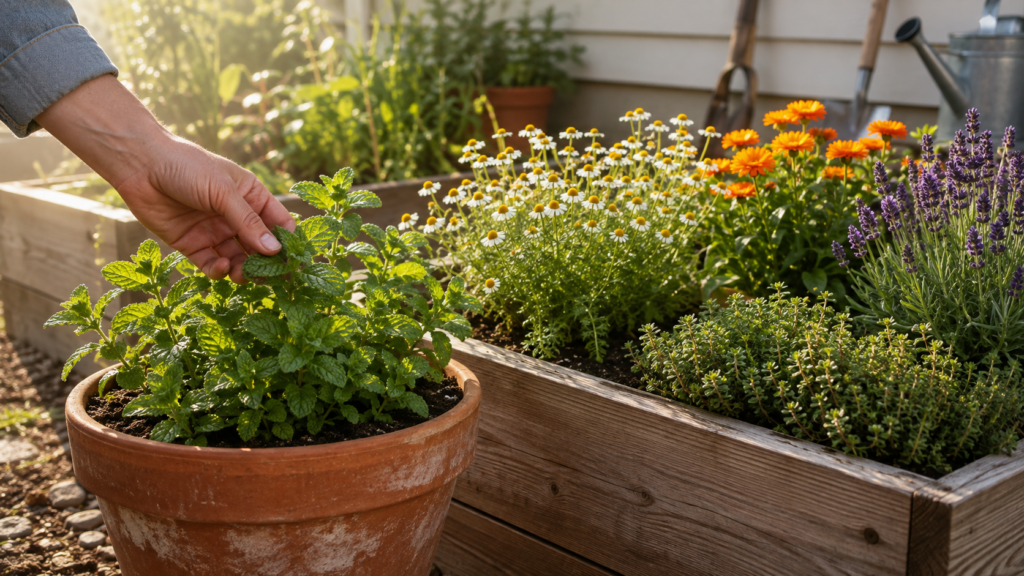
Use labels.
Better still, include the botanical name when available.
For example:
Thyme — Thymus vulgaris
Rather than simply:
HERB
Keep the original seed packet too.
This becomes especially important when plants are being grown because you’re interested in their traditional uses.
Step 8: Create a Tiny Garden Journal
You don’t need a beautiful leather gardening diary.
Your phone works.
A spreadsheet works.
A $2 notebook works.
Record:
| Date | Plant | What Happened |
| May 4 | Chamomile | Seeds planted |
| May 12 | Chamomile | First seedlings |
| May 18 | Mint | Moved to larger pot |
| June 2 | Thyme | Soil staying too wet |
| June 10 | Calendula | First flower buds |
After one growing season, this information becomes incredibly useful.
You’ll know things that no generic gardening article can tell you:
Your balcony gets too hot at 4 PM.
That corner stays damp.
The mint loves that location.
Your lavender definitely doesn’t.
That’s how you start becoming good at gardening.
Step 9: Harvest Without Destroying the Plant
One of the pleasures of growing herbs is eventually harvesting something you’ve grown yourself.
But resist the urge to strip a young plant bare.
Harvesting methods and timing vary depending on the herb and the plant part you’re collecting.
When you’re ready to harvest:
- Correctly identify the plant.
- Use clean tools.
- Research that particular species.
- Avoid taking excessive growth from a young plant.
- Label harvested material.
- Store it appropriately.
General herb-growing guidance recommends harvesting while leaving enough growth for plants to continue developing.
IMPORTANT: A Medicinal Herb Garden Is Still a Garden
The word “medicinal” can create an unfortunate assumption:
If something is natural, it must be safe.
That isn’t a good rule.
Plants can have:
- Different species with similar common names
- Allergic-reaction potential
- Medication interactions
- Different usable and non-usable plant parts
- Pregnancy or health-condition considerations
- Preparation requirements
So growing a plant and deciding whether to consume or medicinally use it are two separate decisions.
This article is about gardening, not diagnosing or treating medical conditions.
Never consume an unfamiliar plant simply because it resembles an online photograph.
If you’re considering medicinal use—especially if you take medication, are pregnant, or have a health condition—get appropriate professional guidance first.
Which Garden Would You Choose?
Here’s a fun way to think about your first setup.
OPTION A — The Apartment Garden
Space: Balcony
Plants: Mint + thyme + chamomile
Setup: Three containers
Commitment: Low
Perfect if you mainly want to experiment.
OPTION B — The Patio Herb Garden
Space: Patio
Plants: Chamomile + calendula + thyme + lemon balm + mint
Setup: Five containers
Commitment: Moderate
This is probably my favorite setup for a complete beginner.
OPTION C — The Backyard Starter Garden
Space: Backyard
Plants: Chamomile + calendula + thyme + lavender + echinacea
Plus: Mint and lemon balm in separate containers
Setup: Small raised bed + two pots
Commitment: Moderate
You get the visual appeal of a garden bed without letting the vigorous plants dominate everything.
The $0 Mistake to Avoid Before Buying Anything
Buying seeds first.
Planning second.
Reverse that.
Before placing an order, answer these seven questions:
1. Where will the plants grow?
2. How much sunlight does that location receive?
3. Am I using pots, a raised bed or the ground?
4. Which plants are appropriate for my climate?
5. Which plants need their own containers?
6. Am I starting from seed or buying plants?
7. Do I actually want to maintain all of these plants?
If you can answer those questions, you’re already ahead of where many first gardens begin.
How Much Space Do You Really Need?
Probably less than you imagine.
A medicinal herb garden can be:
Three pots on a balcony.
Or:
Six containers along a patio wall.
Or:
One small raised bed.
Or eventually:
An entire backyard section.
The size doesn’t determine whether it’s a real garden.
Successful plants do.
Why Starting Small Actually Makes the Garden More Interesting
There’s a temptation to treat gardening like shopping.
More varieties = better garden.
But imagine owning 30 different plants and not knowing:
- Which one needs water
- Why three are turning yellow
- Which seedling is which
- What’s spreading everywhere
- When anything should be harvested
Now compare that with five plants you genuinely understand.
You know the mint immediately by its aroma.
You recognize the first calendula flower.
You’ve figured out exactly how quickly the thyme pot dries.
You know which part of the patio the chamomile prefers.
That’s much more satisfying.
And next season?
Add three more.
Ready to Start Your First Herb Garden?
You don’t need to know everything about herbs before planting your first seed.
You need:
A suitable space.
A few well-chosen plants.
The willingness to pay attention.
Then let the garden teach you the rest.
If you’d prefer to explore a ready-made collection rather than sourcing several traditional-use plants separately, you can take a look at the current Medicinal Garden Kit.
Review the included varieties, check whether they’re appropriate for your growing conditions, and decide whether the convenience of starting with a collection makes sense for you.
Frequently Asked Questions
Can I start a medicinal herb garden in an apartment?
Yes, depending on your available light and the plants you choose. Many herbs can grow in containers, making balconies and patios useful options for people without yards.
What are some beginner-friendly herbs?
Mint, lemon balm, lavender, sage and thyme are among herbs commonly identified as relatively approachable for home gardeners, although each has different growing requirements.
Should beginners use seeds or starter plants?
Either can work. Seeds generally provide a lower-cost way to begin and allow you to experience germination, while nursery transplants let you start with an established plant.
Should mint be planted directly in my garden?
Mint spreads aggressively, so growing it in a container is a common strategy for preventing it from taking over surrounding areas.
How much sunlight do herbs need?
It varies by species. Many popular herbs grow well with substantial sun, but you should check the requirements of each plant rather than applying a single rule to the entire garden.
Do medicinal herbs need special soil?
There isn’t one universal “medicinal herb soil.” Requirements depend on the plant. Good drainage is particularly important for many commonly cultivated herbs.
Is a medicinal herb garden a replacement for medication?
No. Growing traditional-use herbs is gardening. Decisions about treating health conditions or combining herbs with medication belong in an appropriate medical context.
Your First Garden Can Start With One Pot
Maybe you don’t have room for a raised bed.
Maybe you’ve never successfully grown anything.
Maybe you aren’t sure whether you’ll even enjoy gardening.
That’s fine.
Buy—or grow—one herb.
Put it somewhere appropriate.
Learn how it behaves.
Keep it alive.
Then add another.
A year from now, that single pot could be the reason you’re standing beside a garden filled with plants you actually know by sight, smell and habit.
Every garden has to start somewhere.
Yours doesn’t need to start big.
It just needs to start.
Affiliate Disclosure
Disclosure: This article contains affiliate links. If you click one of these links and make a purchase, we may receive a commission at no additional cost to you. We encourage readers to review the product information, included plant varieties, growing requirements, current offer and terms carefully before purchasing. References to traditional or medicinal plants in this article are provided for gardening and educational purposes and are not intended as medical advice.