9 Easy Medicinal Herbs to Grow at Home for Beginners
Some gardening articles make starting an herb garden sound like you need a greenhouse, years of experience and an encyclopedic knowledge of botany.
You don’t.
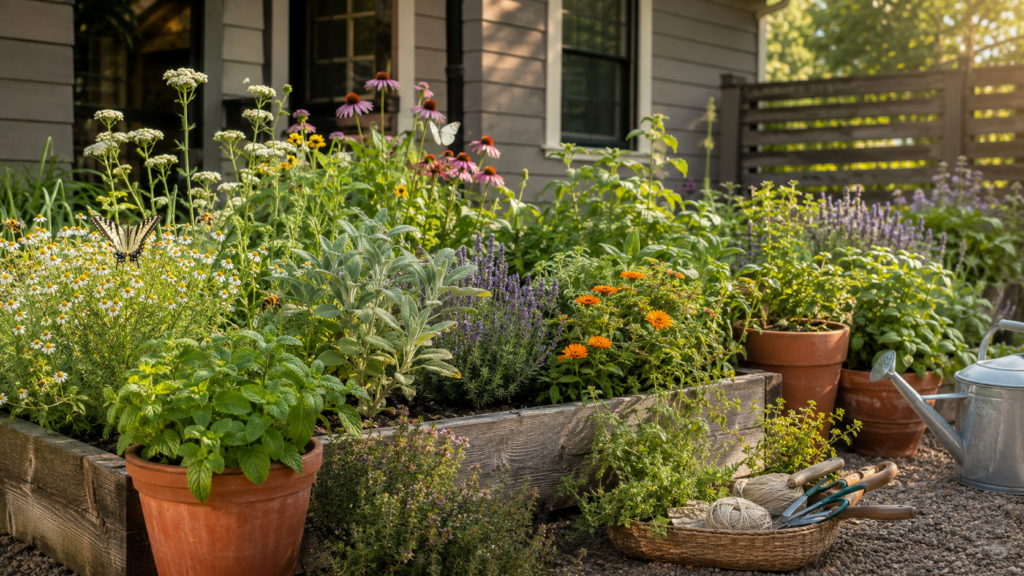
Your first herb garden could be as simple as a few containers on a sunny patio.
One pot of thyme.
One overflowing mint plant.
A patch of cheerful calendula.
Chamomile flowers moving in the breeze.
And maybe a lavender plant that makes the whole corner smell better whenever you walk past it.
Growing herbs at home is appealing because you’re not just growing something decorative. Many herbs offer fragrance, flowers, culinary value, pollinator appeal or a connection to centuries of traditional plant use.
And several are surprisingly approachable for beginners.
The Royal Horticultural Society specifically recommends herbs including mint, thyme and sage for container growing, while Penn State Master Gardeners include sage, mint, thyme and lavender among common low-maintenance choices for new herb gardeners.
So which plants should you actually start with?
Here are nine medicinal herbs to grow at home that are worth considering—and, more importantly, what you need to know before planting each one.
First, Here’s the 30-Second Version
Not sure which herb suits you?
Use this table before reading the individual profiles.
| Herb | Beginner Appeal | Good in Containers? | Main Reason to Grow It |
|---|---|---|---|
| Chamomile | ★★★★★ | Yes | Pretty flowers + traditional herb garden |
| Calendula | ★★★★★ | Yes | Color + pollinator appeal |
| Peppermint | ★★★★★ | Yes — recommended | Vigorous, fragrant growth |
| Lemon Balm | ★★★★★ | Yes — recommended | Citrus-like fragrance |
| Thyme | ★★★★★ | Yes | Compact + culinary value |
| Lavender | ★★★★☆ | Yes | Fragrance + flowers |
| Sage | ★★★★☆ | Yes | Culinary + ornamental |
| Echinacea | ★★★☆☆ | Possible | Striking flowers |
| Yarrow | ★★★☆☆ | Possible | Hardy garden presence |
If you want the easiest possible starting point:
Begin with mint, thyme, calendula and chamomile rather than trying to grow all nine at once.
1. Chamomile: The Herb That Makes Your Garden Look Like a Meadow
Beginner level: ★★★★★
Best for: Pots, beds and cottage-style gardens
Why grow it: Small daisy-like flowers
Watch out for: Knowing which chamomile you’re growing
Chamomile is one of those plants that immediately makes an herb garden more interesting.
Instead of another pot filled entirely with green leaves, you get masses of delicate white flowers with yellow centers.
It has a relaxed, slightly wild appearance that works especially well if you don’t want your garden to look overly manicured.
German chamomile (Matricaria chamomilla) is among the plants highlighted by University of Minnesota Extension in its 2026 guide to planning a healing garden.
Why beginners may enjoy it
Chamomile gives you a visible payoff.
Flowers make it easy to see that something is happening in the garden, which sounds trivial until you’ve spent weeks staring at three nearly identical pots of green seedlings.
Beginner mistake to avoid
Don’t assume every plant called “chamomile” is identical.
Keep the original seed packet and botanical name so you know exactly what you’re growing.
BEST FOR:
The gardener who wants:
🌼 Flowers
🐝 A more pollinator-friendly-looking garden
🪴 Something attractive enough to grow near a patio
2. Calendula: For People Who Think Herb Gardens Need More Color
Beginner level: ★★★★★
Best for: Beds, borders and containers
Why grow it: Bright yellow and orange flowers
Watch out for: Forgetting that flowers need space too
If your mental picture of an herb garden is:
green
green
green
green
green…
Plant some calendula.
Its bright flowers can completely change the look of a small herb garden.
Instead of the garden feeling like a collection of utility plants, it starts looking deliberately designed.
Calendula is also recognized as an edible flower by University of Minnesota Extension, which lists it alongside several other garden plants traditionally used in foods and teas.
Why I like it for a beginner garden
It gives the garden personality.
Imagine five pots:
- Mint
- Thyme
- Lemon balm
- Sage
- Calendula
The calendula immediately becomes the visual centerpiece.
Beginner mistake to avoid
Don’t cram every plant together simply because the seedlings initially look tiny.
Check mature size and spacing requirements before planting.
3. Peppermint: Probably the Plant Most Likely to Make You Feel Like a Gardening Genius
Beginner level: ★★★★★
Best for: Its own container
Why grow it: Vigorous growth and unmistakable fragrance
Watch out for: Vigorous growth and unmistakable enthusiasm
Mint is almost suspiciously eager to grow.
A small mint plant can go from:
“Look at my cute little herb.”
to:
“Why does mint now own this entire section of my garden?”
That enthusiasm is one reason mint is satisfying for beginners.
It’s also why you should think carefully about where you plant it.
The RHS recommends growing mint in its own pot because its roots can spread into neighboring plants, and Penn State likewise recommends pots for invasive perennial herbs including mint.
THE MINT RULE
✅ DO:
Put mint in a container.
❌ DON’T:
Casually plant it in the middle of a small mixed herb bed and assume everyone will peacefully coexist forever.
Why beginners love it
Rub a leaf between your fingers.
You immediately get that recognizable mint fragrance.
That’s part of what makes growing herbs more rewarding than simply looking at them.
4. Lemon Balm: The Plant You Notice With Your Nose First
Beginner level: ★★★★★
Best for: Containers or controlled garden areas
Why grow it: Fresh citrus-like scent
Watch out for: Spreading
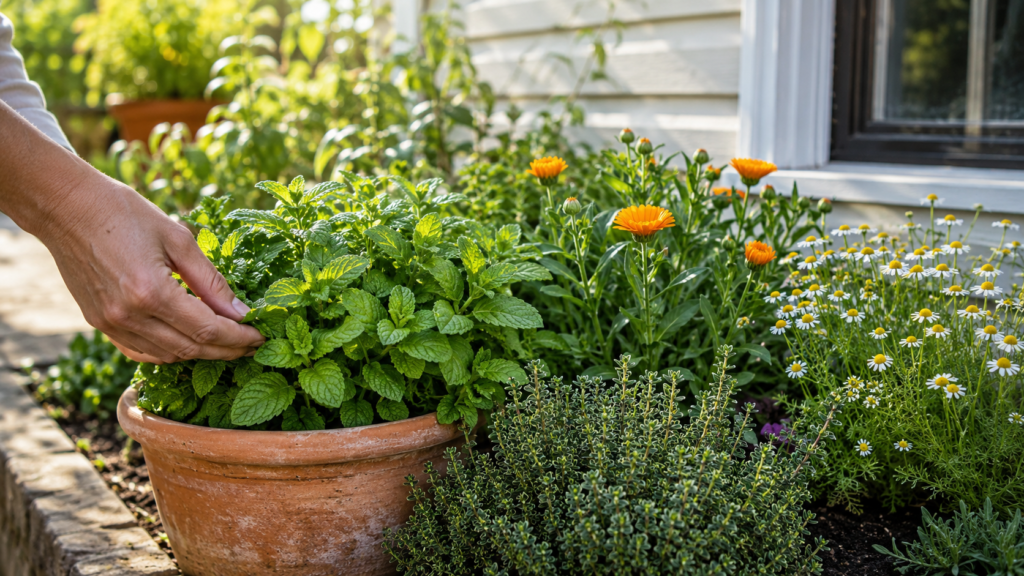
Lemon balm doesn’t need dramatic flowers to get your attention.
Its fragrance does the job.
Brush the foliage, and you’ll understand why “lemon” ended up in the name.
University of Minnesota Extension identifies lemon balm (Melissa officinalis) as a citrus-scented perennial in its healing-garden guide.
There is, however, something lemon balm has in common with mint:
It can be enthusiastic.
Penn State categorizes both mint and lemon balm among perennial herbs that are sensible to grow in pots when you want to control them.
The easy solution
Give it a container.
Problem largely solved.
BEST FOR:
Someone who cares as much about fragrance and sensory enjoyment as they do about how the garden looks.
5. Thyme: The Small Herb That Earns Its Space
Beginner level: ★★★★★
Best for: Containers, beds and sunny kitchen gardens
Why grow it: Compact size + culinary usefulness
Watch out for: Keeping it unnecessarily wet
If I were building a garden where every plant had to justify the space it occupied, thyme would make the cut.
It doesn’t demand the visual footprint of a large plant.
It smells good.
It’s widely used in cooking.
And it works particularly well in containers.
The RHS describes thyme as an easy-to-grow aromatic herb suitable for containers, while University of Minnesota Extension describes common thyme as fragrant, hardy and versatile.
Why it’s an excellent beginner herb
Even if you eventually decide traditional herbalism isn’t something you’re interested in, you’re still left with an extremely useful culinary herb.
That’s an important consideration.
Your herb garden should contain plants you’ll genuinely enjoy having.
QUICK PAUSE: WHICH ONE SOUNDS LIKE YOU?
“I want something almost impossible to ignore.”
→ Try mint
“I mainly want beautiful flowers.”
→ Try calendula or chamomile
“I want something useful in my kitchen.”
→ Try thyme
“I want my garden to smell incredible.”
→ Consider lemon balm or lavender
“I have almost no space.”
→ Start with two or three containers, not an entire garden bed.
Want to Start With a Collection Instead of Hunting Down Seeds One by One?
You certainly don’t need a kit to start an herb garden.
You can source individual seeds and plants yourself.
But if the idea of choosing several traditional-use varieties from different sources sounds like more work than you want, the Medicinal Garden Kit is designed around providing a collection in one place.
Before purchasing, check the current plants included in the kit and make sure they’re appropriate for your climate, available space and household.
6. Lavender: The One People Will Actually Ask You About
Beginner level: ★★★★☆
Best for: Sunny, well-drained locations and suitable containers
Why grow it: Fragrance, flowers and garden appearance
Watch out for: Treating it like a moisture-loving plant
There are practical herbs.
And then some herbs become part of how the garden looks.
Lavender does both.
Its shape, fragrance and purple flowers make it visually different from most ordinary culinary herbs.
The RHS includes lavender among common herbs and emphasizes matching herbs to suitable growing conditions, while Penn State includes lavender among the common low-maintenance herbs suitable for beginners.
Why lavender is interesting
Imagine a patio with:
A terracotta mint pot.
A small thyme container.
Calendula flowers.
And one flowering lavender plant.
You no longer have “some herbs.”
You have something that looks like an intentional garden.
Beginner mistake to avoid
Don’t assume every herb wants identical moisture and soil conditions.
Research the needs of the specific lavender you’re planting, particularly drainage and climate suitability.
7. Sage: The Herb That Looks Good Even When You’re Not Harvesting It
Beginner level: ★★★★☆
Best for: Containers and herb beds
Why grow it: Attractive foliage + culinary versatility
Watch out for: Poor drainage and overcrowding
Sage deserves more attention than it gets.
Its textured foliage gives an herb garden a different look, and it’s another plant that can justify its space simply through culinary use.
Penn State includes sage among its recommended common low-maintenance herbs for people starting an herb garden, while the RHS includes sage among herbs suitable for container cultivation.
Pair it with:
Thyme + sage + lavender
and you’ve created a completely different visual style from:
Mint + lemon balm + chamomile.
That’s part of the fun.
There isn’t one “correct” medicinal herb garden.
8. Echinacea: When You Want the Herb Garden to Look Like a Flower Garden
Beginner level: ★★★☆☆
Best for: Garden beds and appropriate larger containers
Why grow it: Large, distinctive flowers
Watch out for: Choosing it without checking your local growing conditions
If most of your herbs live low to the ground, echinacea can add vertical interest and prominent blooms.
Its flowers give a mixed herb garden much more of a traditional garden appearance.
This is the type of plant I’d choose after establishing the simpler herbs rather than making it the first seed you’ve ever attempted to grow.
Why?
Because your first garden doesn’t need nine experiments happening simultaneously.
Build confidence first.
Add variety second.
9. Yarrow: For a More Natural, Meadow-Like Garden
Beginner level: ★★★☆☆
Best for: Garden beds and naturalistic plantings
Why grow it: Distinctive flower clusters and hardy garden character
Watch out for: Plant identification and spreading habits
Yarrow gives a garden a completely different appearance from tidy pots of thyme and mint.
It’s more naturalistic.
Less kitchen windowsill.
More meadow.
Penn State lists yarrow among plants suited to sunny, relatively dry conditions in its perennial-plant guidance.
It’s an interesting choice once you move beyond the “five pots on the patio” phase and want your herb garden to become part of a larger landscape.
Now Let’s Build YOUR Garden
Reading about nine plants is easy.
Choosing them is harder.
So don’t choose nine.
Pick a garden personality instead.
🌿 OPTION 1 — THE ABSOLUTE BEGINNER
Choose:
- Mint
- Thyme
- Calendula
Setup: Three containers
Why this works:
Small commitment, obvious differences between plants and very little space required.
Best if:
You’ve never successfully grown anything before.
🌸 OPTION 2 — THE BEAUTIFUL HERB GARDEN
Choose:
- Chamomile
- Calendula
- Lavender
- Thyme
- Echinacea
Setup: Small raised bed or mixed containers
Why this works:
You’re choosing plants partly for flowers and visual appeal rather than only utility.
Best if:
The garden will be somewhere you actually sit and enjoy.
🌿 OPTION 3 — THE SMALL-SPACE GARDEN
Choose:
- Mint
- Lemon balm
- Thyme
- Sage
Setup: Four individual containers
Why this works:
No garden bed required.
Herbs can grow well in containers when provided with suitable conditions and drainage.
Best if:
You live in an apartment, condo or townhouse.
🌼 OPTION 4 — THE “I’M PROBABLY GOING TO GET INTO THIS” GARDEN
Choose:
- Chamomile
- Calendula
- Thyme
- Lavender
- Sage
- Echinacea
Plus separate containers for:
- Mint
- Lemon balm
Best if:
You’ve already decided gardening is going to become a real hobby.
The Beginner Mistake Nobody Talks About: Growing Too Much
This is one of those situations where enthusiasm works against you.
You discover herb gardening on Saturday.
By Sunday you’ve ordered:
27 varieties.
Five seed trays.
Three types of soil.
A grow light.
A shelving system.
And something called “marshmallow root” that you don’t actually remember adding to the cart.
Then everything germinates at different times.
Some plants need repotting.
Others don’t germinate.
The mint is taking over.
You can’t remember what three seedlings are.
And gardening starts feeling like another job.
Don’t do that.
Start with:
3–5 plants.
Learn them.
Then expand.
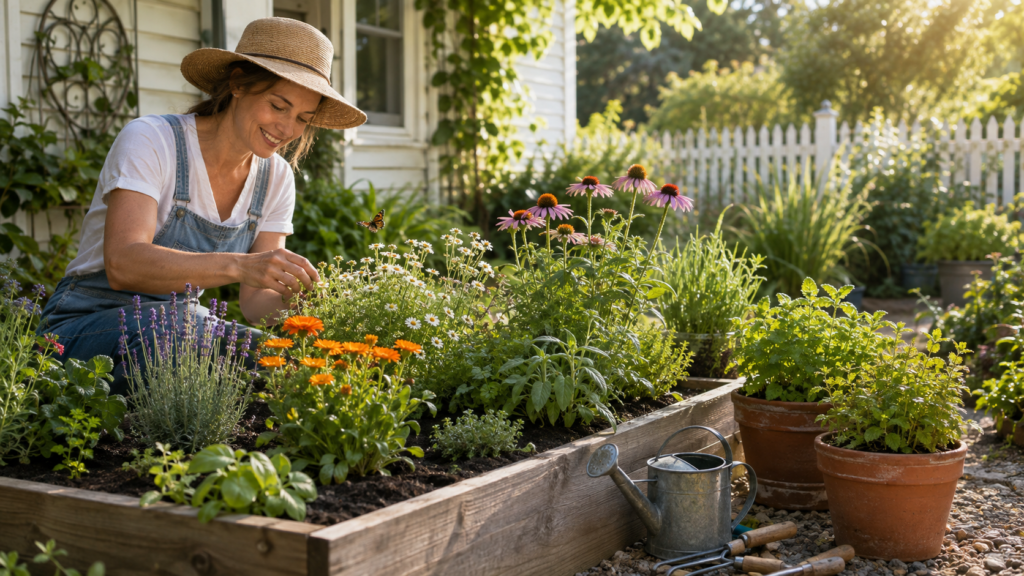
A tiny garden you maintain is better than an ambitious garden you abandon.
The “One Pot Test”
If you’re genuinely unsure whether you’ll enjoy herb gardening, here’s an even simpler strategy.
Buy one pot.
Grow one herb.
I’d choose either:
Mint — if you want vigorous growth.
or
Thyme — if you want something compact and culinary.
Spend a month paying attention to it.
Check the soil.
Watch new leaves emerge.
Notice how sunlight moves across your space.
If you enjoy the process?
Add two more plants.
There is absolutely no requirement that your medicinal herb garden appear overnight.
What You Need to Start — And What You Don’t
YOU PROBABLY NEED:
- Suitable seeds or plants
- Containers or garden space
- Appropriate growing medium
- Drainage
- Water
- Adequate light
- Plant labels
- Basic hand tools
YOU PROBABLY DON’T NEED ON DAY ONE:
- A greenhouse
- 30 herb varieties
- Expensive automated irrigation
- Fancy gardening software
- Professional raised beds
- A massive seed-starting station
- Every gardening tool sold at the hardware store
Start simple.
Upgrade when something creates an actual need.
Give Mint and Lemon Balm Their Own Apartments
If there is one idea worth repeating, it’s this.
Some plants are good neighbors.
Some want to expand the property line.
Penn State specifically identifies mint and lemon balm as invasive perennials that are sensible to grow in pots, while RHS also recommends containing mint because of its spreading roots.
So instead of fighting them later:
Containerize them from the beginning.
A beautiful terracotta pot can actually make the garden look better anyway.
Don’t Forget Why You’re Growing Them
This sounds obvious, but it’s important.
If you hate the smell of lavender…
Don’t grow lavender simply because it appeared on a “must-have medicinal herbs” list.
If you cook with thyme every week?
Grow thyme.
Love colorful flowers?
Calendula might deserve more space.
Have an apartment balcony?
Container-friendly plants suddenly become much more important.
Your garden should reflect your life, not somebody else’s checklist.
A Note About the Word “Medicinal”
There’s an important difference between:
growing a plant associated with traditional herbal use
and
using that plant to treat a medical condition.
Those are not the same thing.
Something being “natural” does not automatically make it safe. The U.S. National Center for Complementary and Integrative Health notes that herbal products can interact with medicines and that natural products are not inherently safer simply because they’re natural.
So enjoy these plants for:
- Gardening
- Fragrance
- Flowers
- Culinary uses where appropriate
- Pollinator value
- Learning about traditional plants
But don’t assume that because you successfully grew a plant, you automatically know how—or whether—it should be used medicinally.
If you’re considering using an herb medicinally, particularly while taking medication or managing a health condition, discuss that with an appropriately qualified healthcare professional.
BEFORE YOU BUY SEEDS: THE 7-QUESTION TEST
Use this before adding another variety to your garden.
1. Do I have enough light for this plant?
2. Is it suitable for my climate?
3. Will I grow it in a pot or garden bed?
4. How large will it become?
5. Does it spread aggressively?
6. Do I actually want this plant?
7. Can I confidently identify it later?
If you can’t answer those questions yet, don’t click Buy.
Spend five minutes researching the plant first.
Your future garden will be easier to manage.
Want to Turn the Idea Into an Actual Garden?
Reading about herbs is the easy part.
Eventually you have to put something in the soil.
You can absolutely build your garden by sourcing every seed or starter plant individually.
But if you’d rather begin by exploring a curated collection of traditional-use plants, you can check the current Medicinal Garden Kit.
Don’t purchase it simply because it contains multiple varieties.
Look at what’s actually included.
Check those plants against:
Your climate.
Your available sunlight.
Your garden space.
What you genuinely want to grow.
Then decide whether getting a collection together makes more sense for you than sourcing the plants separately.
Frequently Asked Questions
What medicinal herbs are easiest to grow at home?
For beginners, common low-maintenance herbs such as mint, thyme, sage and lavender are reasonable plants to investigate. Penn State Master Gardeners specifically include these among commonly recommended beginner herbs.
Your actual results will depend on climate, sunlight, soil, containers and care.
Can medicinal herbs be grown in containers?
Many herbs can. The RHS specifically recommends container growing for herbs including mint, thyme and sage.
Containers are especially useful when space is limited or when you need to control an aggressive plant.
What is the best medicinal herb for a balcony?
There isn’t one universal best plant, but container-friendly herbs such as thyme and mint can be good candidates when the light and climate are suitable. Keep mint in its own container.
Should mint be planted in a garden bed?
It can be, but mint spreads vigorously. RHS recommends restricting its roots with a container if growing it in beds or borders.
For a beginner, a separate container is often simpler.
Can I grow several herbs in one container?
Sometimes, but only when the plants have compatible growing requirements and enough space.
Don’t group herbs merely because they look attractive together. Consider moisture, sunlight, mature size and growth habits.
How many herbs should a beginner grow?
There’s no required number, but three to five plants is a manageable way to start. The objective isn’t collecting varieties—it’s successfully learning to grow them.
Are home-grown medicinal herbs automatically safe to consume?
No. “Natural” does not automatically mean safe, and herbs can have medication interactions or other risks.
Correct species identification and appropriate guidance matter if you’re considering medicinal use.
If You Remember Only One Thing…
Don’t try to build the ultimate herb garden this weekend.
Choose three plants.
For example:
Mint
Give it its own pot.
Thyme
Put it somewhere appropriate for its growing needs.
Calendula
Add something colorful.
Now you have a garden.
Observe it.
Learn it.
Let something fail.
Figure out why.
Then add chamomile.
Maybe lavender after that.
Eventually, those three little plants can become a garden containing herbs you recognize not because you’ve memorized their names from an article—
but because you’ve watched each one grow.
That’s the point.
Affiliate Disclosure
Disclosure: This article contains affiliate links. If you click one of these links and make a purchase, we may receive a commission at no additional cost to you. We encourage you to review the product information, included seed varieties, growing requirements, current offer and purchase terms before deciding whether a product is right for you. References to medicinal or traditional-use herbs in this article are provided for gardening and educational purposes only and are not intended to diagnose, treat, cure or prevent any medical condition.